MYP Sciences Year 3
About Course
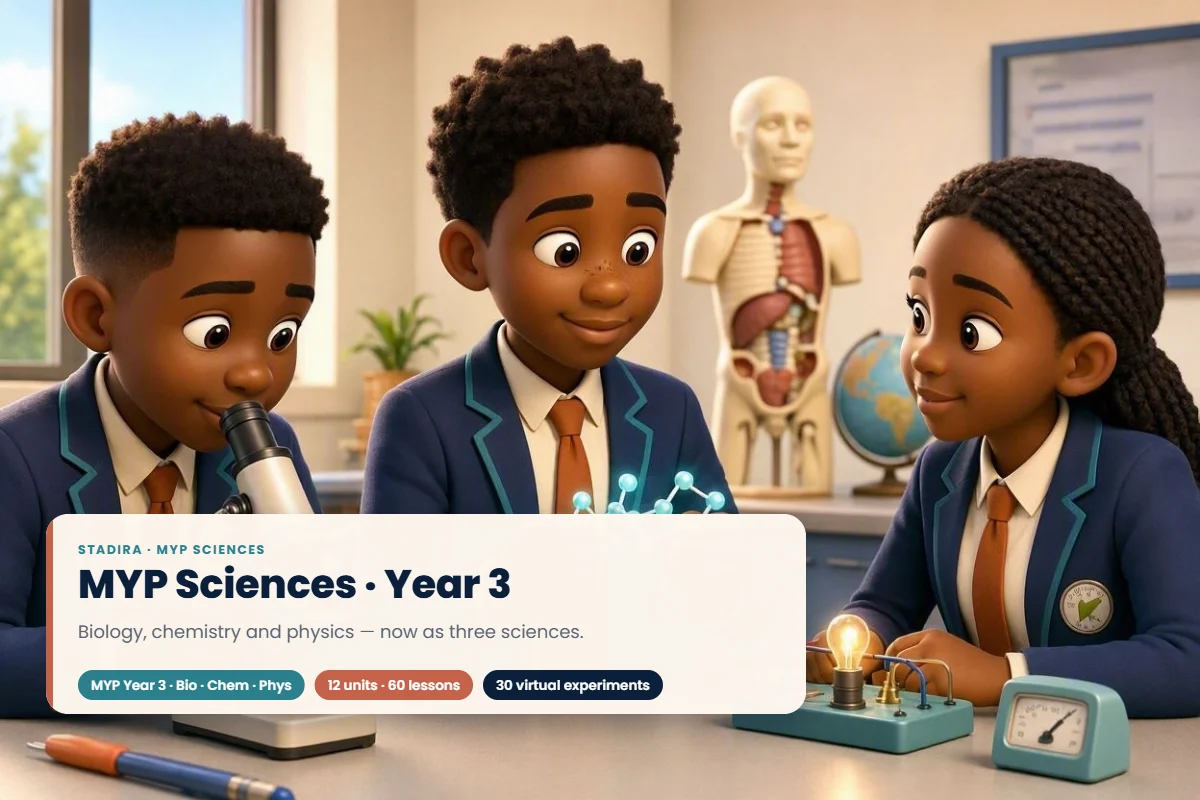
MYP Sciences Year 3 is the third of five courses that take a student from the start of the Middle Years Programme to the on-screen eAssessment — taught the way a good science teacher teaches: a puzzle first, an experiment you run yourself, then the explanation, the story of how humans worked it out, where it is used today, and questions whose answers you reveal only after you have tried.
What changes in Year 3
Years 1 and 2 taught science as one subject. Year 3 is where it separates into Biology, Chemistry and Physics, following the IB’s own discipline overviews — and where the work turns quantitative. Students balance symbol equations, calculate specific heat capacity and resistance, find a refractive index from a table of sines, read a velocity–time graph for its gradient and its area, and test whether a relationship is proportional or merely linear. The four assessment criteria are the same; the standard expected of an answer is higher.
The twelve units
Biology. Body systems — digestion, ventilation, circulation, control and excretion, movement and reproduction. Photosynthesis and respiration — the equations, the leaf, limiting factors, feeding the world, and the energy every cell releases. Ecosystems — from one organism to the biosphere, biomes, sampling, competition and niche, predators and prey. Classification, variation and natural selection — the five kingdoms, naming and keys, variation, Darwin, and the evidence from fossils to antibiotic resistance.
Chemistry. Atomic structure and bonding — models and evidence, electron configuration, ionic, covalent and metallic bonding. Energy and chemical change — physical against chemical change, symbol equations and balancing, types of reaction, exothermic and endothermic, and the products people build from them. Solutions, acids and bases — dissolving and concentration, the pH scale, strong against concentrated, and acids and bases in the world. Environmental cycles and climate change — water, carbon and nitrogen, weather against climate, and how a country powers itself.
Physics. Mechanics and space exploration — motion and its graphs, forces, gravity, the Solar System by the numbers, and how to judge a claim about space. Heat — heat against temperature, the three ways heat moves, specific heat capacity, and thermal expansion. Circuits — charge and current, series and parallel, circuit calculations and power, and electricity in a community. Light and sound — rays and shadows, reflection, refraction and colour, how sound travels, and how the eye and the ear work.
What is inside each unit
- Five lessons, each opening with a puzzle, building the science in numbered steps with worked examples, and closing with exam-style questions and a summary.
- A virtual experiment in almost every lesson — thirty new ones for Year 3, from a Leslie cube and a dial gauge to a titration curve, a wind turbine and a predator–prey model. You choose the variables, take readings, build the table and the graph, and write the method yourself.
- A Think like a scientist task in every lesson, set against one of the four criteria, with a full-mark model answer to compare your own writing with once you have written it.
- Check yourself — seven questions per lesson with the reasoning behind every answer, unlimited attempts, nothing counted against you.
- A 90-minute unit test following the on-screen examination structure: Task 1 knowing and understanding, Task 2 an investigation, Task 3 science in the real world, with the mark scheme and level descriptors behind a reveal.
Who it is for
Students in MYP Year 3 (typically age 13–14) anywhere in the world, and any student who has finished Year 2 or wants the third year of biology, chemistry and physics built properly. Examples come from Botswana and from other countries; the science is the same wherever you sit.
How the marking works
You write your own answers and compare them with the model answers and mark schemes provided. Nothing on this course marks your extended writing for you — comparing your work against a full-mark answer, and seeing exactly where the marks sit, is how you learn to write one.
Course Content
Unit 1 — Body systems: how the human body keeps itself alive
1.1 Check yourself — Digestion
1.2 Breathing and the lungs: how air reaches every cell
1.2 Check yourself — Breathing and the lungs
1.3 The heart and circulation: one pump, two loops and 100 000 km of pipe
1.3 Check yourself — The heart and circulation
1.4 Control and excretion: how the body holds itself steady
1.4 Check yourself — Control and excretion
1.5 Movement, reproduction and the whole body
1.5 Check yourself — Movement, reproduction and the whole body
Unit 1 Test — Body systems (1 h 30 min, Criteria A–D)
Unit 2 — Photosynthesis and respiration: the energy cycle of life
Unit 3 — Ecosystems: balance, competition and change
Unit 4 — Classification, variation and natural selection
Unit 5 — Atomic structure and bonding
Unit 6 — Energy and chemical change
Unit 7 — Solutions, acids and bases
Unit 8 — Environmental cycles and climate change
Unit 9 — Mechanics and space exploration
Unit 10 — Heat
Unit 11 — Circuits
Unit 12 — Light and sound
Student Ratings & Reviews