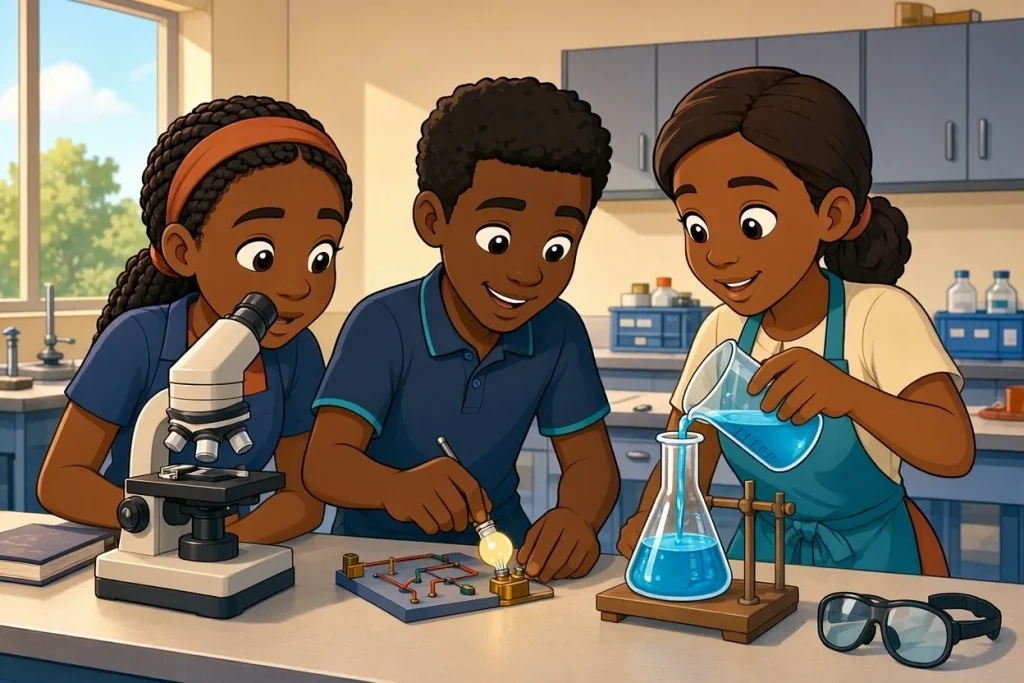
Science that makes sense — from Form 1 all the way to IGCSE.
Six new online courses take a student from their first science lesson in secondary school to the final IGCSE Biology, Chemistry and Physics papers. You do not need a tutor to follow them. Each lesson teaches the idea, shows how it is examined and lets you practise until you are sure.
Science is where many good students lose marks they should have kept. They know the facts, but the exam asks them to explain, calculate, read a graph or plan an experiment — and nobody showed them how. These courses are built to close that gap, one step at a time.
The route: one course for each year
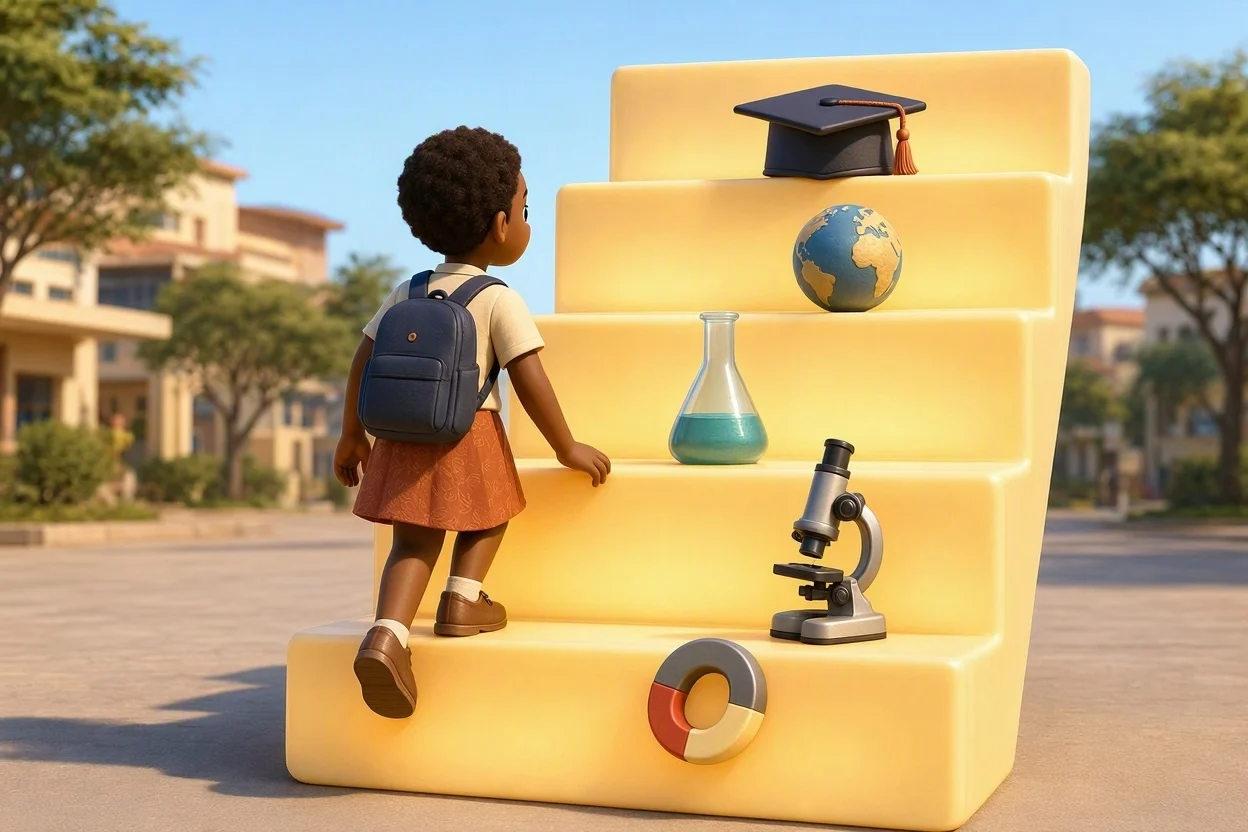
The courses form a ladder. Every idea you meet in Form 1 is used again later, so nothing has to be relearned when IGCSE starts.
Joining in Form 4? Go straight to the IGCSE course for your subject. Each one starts from the beginning of the syllabus and marks the Extended-only content clearly, so it works whichever paper you are entered for.
What is inside every lesson
Big, clear notes
Large text, short paragraphs and colourful diagrams you can actually read on a phone.
Worked examples
Every calculation is written one step per line — formula, substitution, answer with its unit — the way an examiner wants to see it.
Model answers
Practice questions with answers you reveal only when you are ready, so you test yourself first.
A quiz after every lesson
Each quiz explains why every answer is right or wrong, so a wrong answer still teaches you something.
Virtual experiments with real results

Practical skills are where many IGCSE marks are won or lost, and many students rarely get to do the experiments themselves. The courses include virtual practicals you run yourself: you take the reading from the scale, record it in a results table, spot the anomaly, plot the graph, draw the line of best fit and answer the questions a practical paper asks.
| Course | Virtual practicals include |
|---|---|
| IGCSE Physics 0625 | Hooke’s law, the pendulum, density, liquid pressure, cooling curves, refraction, resistance, electromagnets and half-life |
| IGCSE Chemistry 0620 | Chromatography, rates with a gas syringe and with marble chips, thermometric titration and copper plating |
| IGCSE Biology 0610 | Osmosis in potato, enzyme activity with catalase, photosynthesis in pondweed, the potometer and respiration in seeds |
| Science Forms 1–3 | Experiments in 9 to 12 lessons of each course, from measuring and density to reaction rates and electromagnets |
Why it matters: the Alternative to Practical paper (Paper 6) rewards students who have handled real data. Taking readings, drawing tables and plotting graphs again and again is the best preparation for it.
Five mock sets that revise the whole syllabus
Each IGCSE science comes with five full mock sets modelled on the most recent papers:
- Paper 1 (Core multiple choice) and Paper 3 (Core theory)
- Paper 2 (Extended multiple choice) and Paper 4 (Extended theory)
- Paper 6 (Alternative to Practical)
That is 25 papers per subject. Together the five sets test every point on the syllabus. They are not a random pile of questions.
Every paper ends with a marking key that is written to teach. It shows how to answer in stages, where each mark comes from, the mistakes examiners see most often, and the exact lesson to go back to. Core students sit Papers 1, 3 and 6. Extended students sit Papers 2, 4 and 6.
Core or Extended?

Both are in the same course. Extended content is clearly labelled, so a Core candidate can skip it and an Extended candidate can see exactly what is extra. If you are unsure which paper you will sit, ask your school. Until then, work through everything and let the Core mocks show you where you stand.
Prices and how to start
Each IGCSE science is P999 a year. Each Form 1–3 course is P699 a year. That gives full access to every lesson, practical, quiz and mock paper for the year. Nothing renews automatically.
Not sure which course to start with? Tell us the year group and the syllabus and we will name the right one.