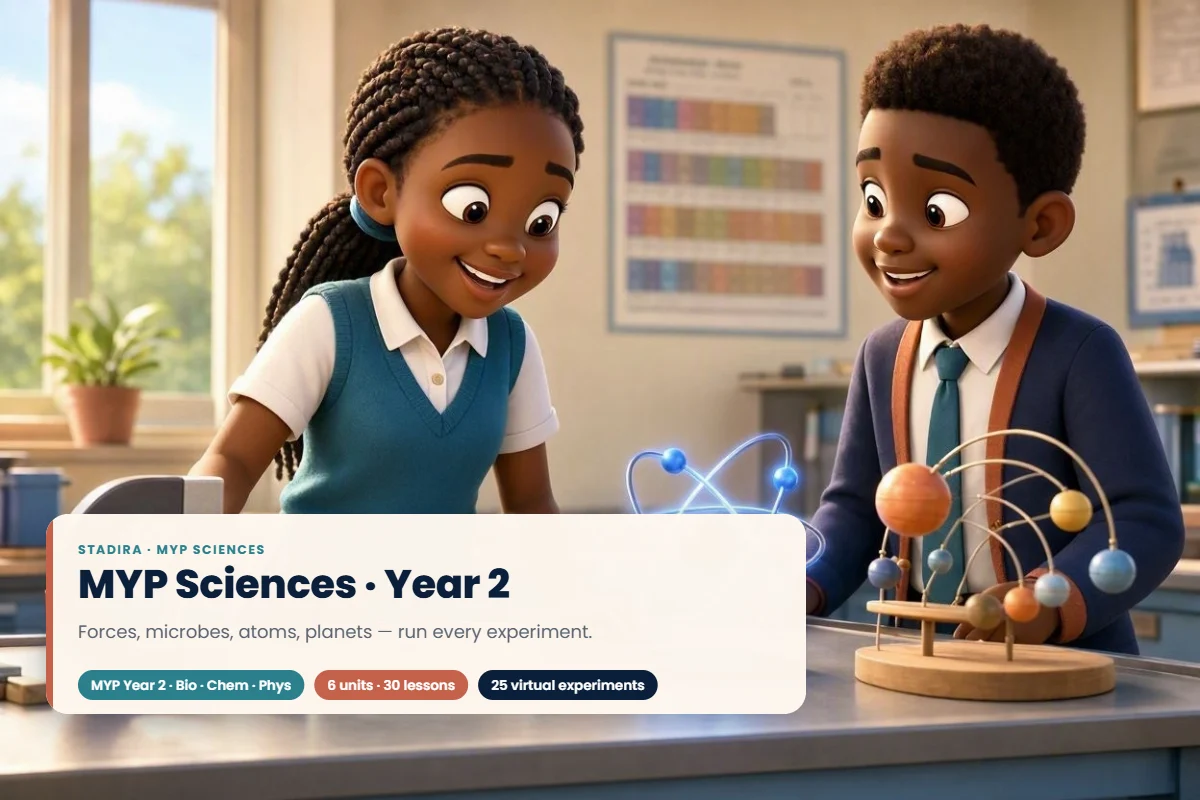
MYP Sciences Year 2
About Course
MYP Sciences Year 2 is the second of five courses that take a student from the start of the Middle Years Programme to the on-screen eAssessment — taught the way a good science teacher teaches: a puzzle first, an experiment you run yourself, then the explanation, the story of how humans worked it out, where it is used today, and questions with answers you reveal only after you have tried.
Who it is for
Students in MYP Year 2 (typically age 12–13) anywhere in the world, and any student who has completed Year 1 or wants the second year of physics, chemistry and biology built properly.
What is inside
Six units following the IB modular overview for Year 2: Interactions (forces as interactions, contact and non-contact forces, resultant force, terminal velocity, crash safety), Infectious diseases (pathogens, transmission, the body’s defences, antibiotics and vaccines), Cell functions (organelles and what they do, respiration, cell division), The periodic table (its history, groups and periods, metals and non-metals, patterns of reactivity), Atoms and their structure (models of the atom, protons, neutrons and electrons, isotopes) and Earth and space (day and night, seasons, the Solar System, gravity and orbits).
Every unit has five lessons with structured notes, a StadiraLab virtual experiment in almost every lesson, worked examples, probing questions with reveal answers, the history of the discovery, real-life and 2026 context, a “Think like a scientist” task on one of the four MYP criteria, and six exam-style questions with marks. Each lesson is followed by a seven-question check-yourself quiz with unlimited attempts, and each unit ends with a 90-minute criterion test (A, B, C and D) with a full mark scheme and level grid.
How to study it
Work through the lessons in order — about an hour each — and run every experiment before reading the science. Write your Think like a scientist answers before opening the model answer. Sit each unit test without notes and mark it honestly; the level grid tells you what to work on next.
Course Content
Unit 1 — Interactions: forces, fields and predicting movement
1.1 Check yourself — What a force is
1.2 Contact forces: friction, drag, tension and the push of a surface
1.2 Check yourself — Contact forces
1.3 Non-contact forces: gravity, magnets and static electricity
1.3 Check yourself — Non-contact forces
1.4 Adding the arrows: balanced forces, resultant force and terminal velocity
1.4 Check yourself — Balanced and unbalanced forces
1.5 Predicting movement: crashes, bridges, sport and rockets
1.5 Check yourself — Predicting movement
Unit 1 Test — Interactions (1 h 30 min, Criteria A–D)
Unit 2 — Infectious diseases: pathogens, defences and cures
Unit 3 — Cell functions: what the parts of a cell do
Unit 4 — The periodic table: patterns among the elements
Unit 5 — Atoms and their structure: models and evidence
Unit 6 — Earth and space: day, night, seasons and orbits
Student Ratings & Reviews