The week Thato almost built a greenhouse
A story about the MYP personal project: why it matters, the traps that cost marks, and how one student turned a giant idea into a project she could finish, explain and be proud of.
Chapter 1 · Monday, 4:15 pm
“I’m going to build a greenhouse”
Thato had it all worked out. Her grandmother grows tomatoes, the summers are getting hotter, and a greenhouse would fix everything. She would build it from recycled bottles, run a campaign at school about food waste, and write a recipe book for good measure.
Her supervisor, Mr Mensah, listened, smiled and asked one question: “What do you want to learn?”
Thato did not have an answer. She had a product, three products in fact, but no learning goal. And she had about 25 hours, including every meeting and the whole report.
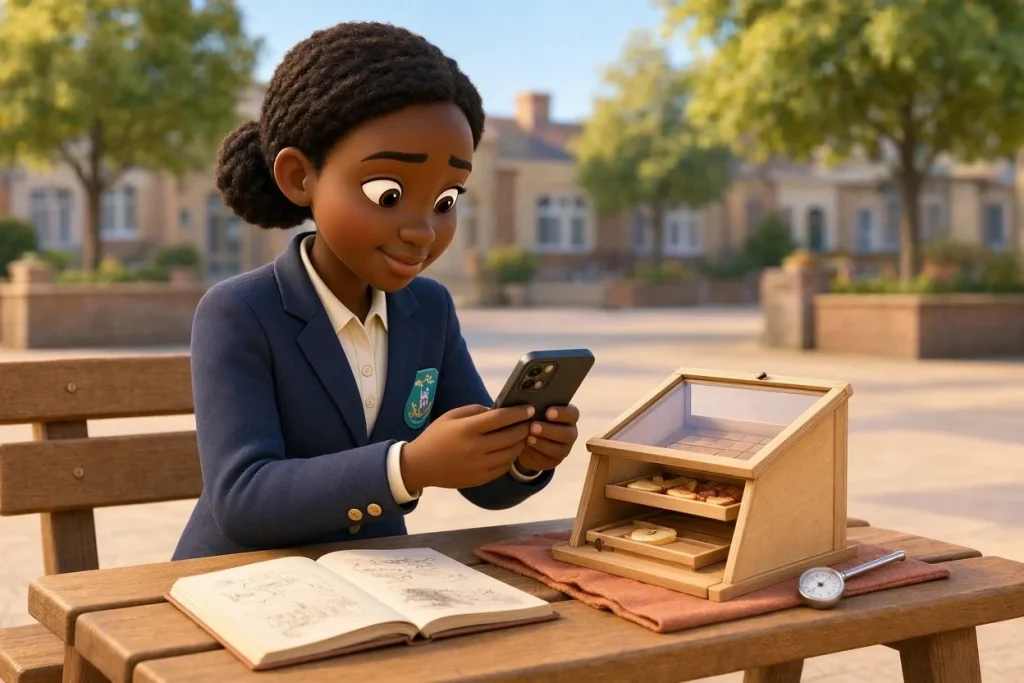
That is the first thing to know about the personal project. You set one goal with two linked parts: a learning goal (what you want to understand) and a product (what you will create with that understanding). You can start from either one. Thato kept her grandmother’s problem and shrank the product: a small solar fruit dryer, and a learning goal about why some dryers trap heat and others do not.
Chapter 2 · Why bother?
Why the personal project matters
Thato’s cousin Kagiso, now in the IB Diploma, put it bluntly: “It’s the first time anyone lets you run your own project from start to finish. And it’s the first time anyone marks you on how you did it, not only on what you made.”
Why the personal project matters in the MYP
- It counts. The MYP certificate needs a grade 3 or higher in the personal project.
- You choose. Your interest, your goal, your product: no one else in the class does the same thing.
- It trains you for what comes next. Planning, evidence, honest evaluation and a structured report are exactly what the Diploma’s internal assessments and Extended Essay ask for.
- Skills you can name. You learn to explain which ATL skills helped you and why, a habit that lasts.
- A story to tell. A finished project is something to talk about in interviews and applications.
Chapter 3 · Thursday, the planning meeting
The five traps
Mr Mensah had supervised many projects. In the meeting he drew five traps on the whiteboard, the ones that cost students marks year after year.
Chapter 4 · The next twelve weeks
How Thato used Personal Project Studio
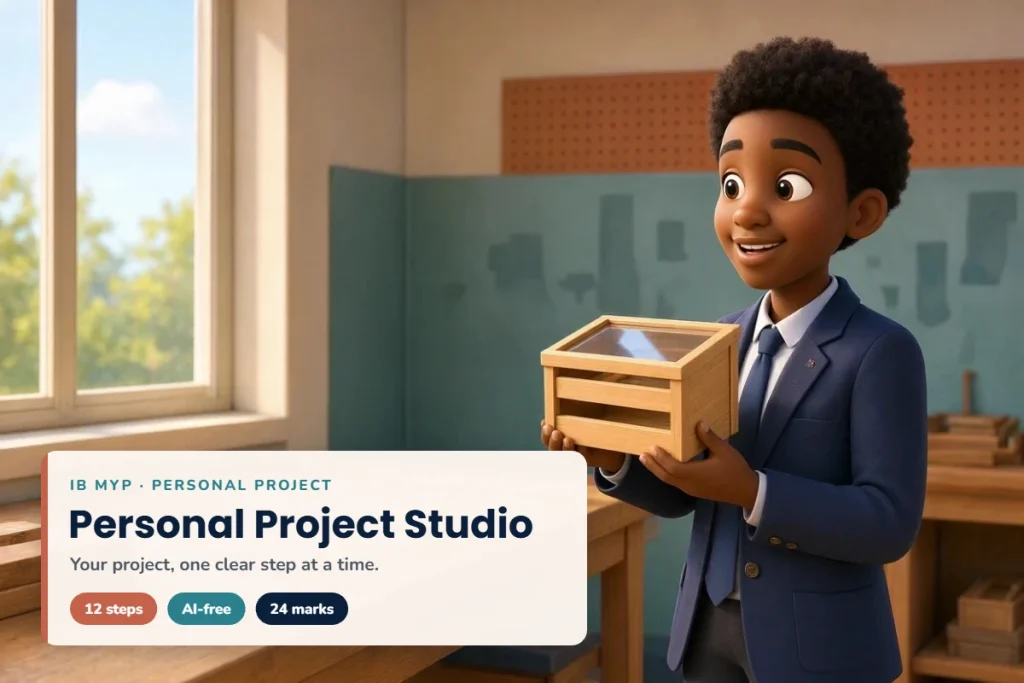
Thato did her project in Personal Project Studio, a step-by-step workspace that walks you through the personal project from first idea to submitted report. It never wrote a word for her. It asked questions, checked her answers against what examiners look for, and kept her on her school’s dates.
- Find my spark: she scored her three ideas on interest, time, cost, safety and help. The greenhouse scored 9 out of 25 for time. The dryer scored 21.
- Goal builder: the live checks caught “raise awareness” in her first learning goal. Mr Mensah approved the second version in the studio.
- Success criteria and plan: “a good temperature” became “45 to 60 °C inside by 11:00 on a sunny day”, with a reason from a food-safety guide. Every criterion got a step that delivers it.
- Evidence log: photos made smaller on her phone, a 30-second voice note after a failed test, each tagged to the strand it proves and dated when she added it.
- Report builder: her own notes from earlier steps at hand, photos placed with one click, a live page count, and a red warning when she typed the school’s name into a caption.
- Self-check and submit: she marked each strand against the level descriptions, wrote her declaration, and copied her meeting notes onto the academic integrity form.
Chapter 5 · Meanwhile, in the staff room
What Mr Mensah saw
Mr Mensah used the free supervisor dashboard. He made a class code, and his students joined with it. He approved goals and plans, completed the safety and ethics check, recorded the three meetings, gave one round of general feedback on each draft, and received the final reports with an anonymity check already done. When two students chose almost the same product, the dashboard told him.
Epilogue
What Thato would tell you
“Make it smaller than you think. Learn something real. Take photos as you go. And when you write, keep asking yourself why.”
A note from the Stadira teaching team: Thato, Kagiso and Mr Mensah are invented, but every trap in this story is one we see in real classrooms every year.
Personal Project Studio at a glance
| Step | What you do | Your supervisor |
|---|---|---|
| 1–2 | The big picture; find your spark; safety and ethics questions | |
| 3 | Learning goal + product, and why your interest led to them | Approves your goal |
| 4–5 | Success criteria; product plan, timeline, hours, risks | Approves your plan, safety check, meeting 1 |
| 6–7 | Evidence log, hours log; ATL skills explained with evidence | Meeting 2 |
| 8–9 | Evaluate the product; reflect on the impact on you | |
| 10 | Report builder, checks, PDF and Word export, bibliography | One round of draft feedback |
| 11–12 | Self-check; declaration and final report; integrity form notes | Receives the report, meeting 3 |
Who it is for
MYP students doing the personal project at any school, in any country, working alone or in a group (each student keeps their own evidence and writes their own report). It works on a phone and a laptop, with large text, read-aloud and key words in several languages.
Price
P499 for 12 months, free with the coupon STADIRA100 until 28 February 2027. Schools can licence the whole MYP 5 year group from P3,500 a year; their students join free with the school’s cohort code (school prices).
How to start
- Open the Personal Project Studio course page and log in (or create a free account).
- Enrol (free with STADIRA100 until 28 February 2027), or, if your school has a Stadira licence, enter its cohort code to join free.
- Read Start here, then open the studio and set up your project.
Questions students ask
Does the studio write my personal project for me?
No. It is AI-free: it never writes or suggests your content. It asks questions, checks what you write and keeps you on track. If you use an AI tool elsewhere, you record it in the AI-use log and credit it.
How long does the personal project take?
About 25 hours in total, including meetings with your supervisor, your own work and writing the report. The studio keeps a running total.
How is the personal project marked?
Three criteria, A Planning, B Applying skills and C Reflecting, each out of 8, so 24 in total. Your supervisor marks it and the IB checks a sample. Grade boundaries are set each session.
Can I use the studio without a supervisor on the site?
Yes. Choose self-study, set your own dates and record your supervisor’s approvals and meetings yourself. You can join a class later without losing anything.
How long can the report be?
Up to 15 pages, at 11 point or larger with 2 cm margins and no title page. A recorded part can replace pages: each minute replaces one page, down to 5 pages plus 10 minutes. The bibliography is a separate file.
Is my evidence private?
Yes. Your photos, voice notes and clips can be opened only by you, your supervisor and Stadira administrators.
Does Stadira send my project to the IB?
No. Your school submits the personal project. The studio helps you prepare it.
Is it free for supervisors?
Yes. Supervisors join at stadira.com/pp-teacher/ with the supervisor code from their coordinator. The coordinator console comes with the school licence.
Start your personal project the calm way
Twelve steps, one at a time, with your supervisor in the loop.
Open Personal Project StudioFor supervisorsPersonal Project Studio is an independent study aid. It is not produced or endorsed by the International Baccalaureate Organization. “IB” and “MYP” are used only to describe the programme it supports.