
The night Lerato almost wrote about “climate change”
A story about the IB internal assessment: why it exists, why it quietly decides so many Diploma grades, and how one student turned a panic at 9:47 pm into a plan. Along the way you will meet IA Studio, the guided workspace we built for exactly this moment.
By the Stadira teaching team · The Study Desk · Updated October 2026
Chapter 1 · 9:47 pmA topic due on Friday, and a blank page
Lerato’s laptop glowed on the kitchen table. Her Maths teacher wanted three candidate IA topics by Friday. She typed the first thing that felt important enough: “Climate change in Africa.” Then she stared at it for twenty minutes.
If you are in DP1 or DP2, you probably know this feeling. The IA (internal assessment) is the one piece of IB work where nobody hands you the question. You have to invent it, plan it, carry it out and write it up, while six subjects, the Extended Essay, TOK and CAS all keep moving.
Lerato’s topic was not a bad interest. It was a bad size. “Climate change in Africa” is a library, not an investigation. Nobody can answer it in 12 to 20 pages, and an examiner would see that in the first paragraph.
By the way: if your topic list looks like Lerato’s, the Maths IA Studio opens with a free “Start here” lesson and a find-my-topic quiz. It asks what you enjoy and suggests topics you can actually finish. Every other studio has one too.
Chapter 2 · Why does the IB even do this?The only exam you sit at your own desk
She sent a voice note to her cousin Tumi, who finished the Diploma two years ago. “Why do they make us do IAs? Can’t they just test us in May?”
Tumi replied with one line: “Because in May they find out what you remember. In the IA they find out what you can do.”
That is the heart of it. A written exam checks knowledge under time pressure. The IA checks something exams cannot: whether you can behave like a mathematician, a scientist, a historian or an economist. Choose a real question, gather evidence, use the subject’s tools properly, and judge the limits of your own work.
Why the IA matters in the IB
Your Diploma score is out of 45: up to 7 points in each of six subjects, plus up to 3 for TOK and the Extended Essay together. The IA sits inside every one of those subject grades. A strong IA can lift a 5 to a 6 before you even walk into the exam hall. A weak one can drag a good exam result down.
And here is what Tumi said next, the part most students miss. The IA has advantages that no exam paper will ever give you:
- Marks banked before May. By exam season, a fifth or more of the grade is already done. That is a real cushion on a bad exam day.
- You choose the question. No other assessment lets you study the thing you are curious about: your town’s taxi fares, your grandmother’s garden, a football league, a local election.
- You control the clock. Weeks instead of hours. Students who plan well turn time into marks.
- University skills, early. Research questions, sources, data, referencing and honest evaluation are exactly what first-year university expects.
- A story to tell. A good IA or Extended Essay gives you something real to talk about in a personal statement or an interview.
By the way: if you are not yet sure which subjects and levels suit you, the Stadira School page shows every course from MYP to the Diploma, and you can ask a teacher a question directly.
Chapter 3 · The group chatFive ways good students lose IA marks
The next morning Lerato asked her DP2 friends what went wrong for them last year. The group chat exploded.
Every year, IB subject reports describe the same few problems. Lerato’s friends had collected most of them:
Kabelo: “My topic was too big.”
He tried to explain “unemployment in Southern Africa” in 1,800 words. Every paragraph only scratched the surface.
The fix: one place, one variable, one period. Narrow until it hurts, then narrow once more.
Mei: “I described, I didn’t explain.”
Beautiful graphs, but each one was followed by “the graph shows an increase”. Mark bands climb from describing to explaining to evaluating, and she stayed on the bottom step.
The fix: after every result, answer “so what?” and “how sure am I?”
Diego: “I went over the word limit.”
By 400 words. Examiners stop reading at the limit, so his evaluation, the best part, was never marked.
The fix: count words section by section, not at the end.
Amara: “My name was on page one.”
IA work must be anonymous. She also forgot to cite the AI tool she used to check her grammar. The IB expects any AI use to be acknowledged, with the prompt and the date.
The fix: run an anonymity and AI-declaration check before you submit.
Everyone: “We ran out of time.”
The IB allows your teacher to give feedback on one complete draft. Hand in half a draft and you waste the only feedback you will get.
The fix: set checkpoints backwards from your final date, and keep them.
By the way: the Sciences IA Studio builds these fixes into the screens: word counts that warn you before the limit, uncertainty and graph tools, and prompts that push you from describing to explaining.
Chapter 4 · The planHow Lerato turned panic into a plan
That evening Lerato opened IA Studio. She expected another long checklist. Instead the screen asked her one question at a time.
- Three set-up cards. Her course (Maths AI, SL), her school, and her deadlines. She entered her teacher’s class code, so the checkpoints came straight from her class.
- The topic quiz. It noticed she loved running. Ten minutes later “climate change in Africa” had become “How does air temperature affect finishing times in my city’s 10 km race?”, with a feasibility check: is the data public, is it enough, is it ethical?
- The aim builder. It flagged “affect” as vague and nudged her to name her variables, place and years.
- A one-page plan to her teacher. The data steps stayed locked until her teacher approved it. Annoying for a day; priceless later.
- Data and maths tools. She pasted race results, and the studio flagged two outliers and showed every working step of her regression, so she could explain it herself.
- Self-check against the criteria. Written in plain student language. She scored herself honestly, saw “Reflection” was weak, and fixed it.
- Draft out, on time. She downloaded a clean draft with an anonymity check and her AI-use declaration, three days before the checkpoint.
Nothing in the studio wrote a single sentence for her. That is deliberate: IA Studio has no AI writing tool inside it. It organises your thinking and shows you what each criterion is looking for, but every word is yours. A tool that writes for you puts your Diploma at risk, and examiners are trained to notice.
By the way: the same journey exists for the Extended Essay, the TOK essay and the TOK exhibition, the three pieces that decide your 3 core points.
Chapter 5 · Feedback dayWhat her teacher saw
On the other side of the screen, Lerato’s teacher opened the class dashboard. Eighteen students. Four plans waiting. Two names in red, three in amber, the rest green.
Her teacher did not need to chase anyone through the corridors. The dashboard showed who was behind a checkpoint and who had gone quiet, and one button sent a polite reminder. Lerato’s draft sat in the “Needs you today” inbox, with a comment bank beside it, ready for the one round of feedback the IB allows.
By the way: if you are a teacher or DP coordinator reading this, IA Studio for Schools explains how to set up a class. Your students open it free with the code STADIRA100 until 28 February 2027, or all year on a school licence. Or go straight to the free teacher sign-up.
EpilogueWhat Lerato tells DP1 students now
“Pick something small that you actually care about. Plan backwards from the deadline. Hand in a complete draft. And never let anything write it for you.”
That is the whole secret of the IA. It is not about being the cleverest person in the room. It is about a focused question, honest evidence, clear explanation and steady time. Do those four things and the IA becomes the part of the Diploma you can be most sure of.
A note from the Stadira teaching team. Lerato is a character, but every trap in her story comes straight from real IA classrooms and IB examiner reports. Every studio is built from the current IB subject guide for its task, including the new guides arriving from 2027, with original examples written and reviewed by qualified teachers.
Ready to start your own story? Below you will find every studio, how they compare, and how to get access free.
The 15 studios, with links
Each studio has a free Start here page you can open before you sign up, showing your steps, how the work is marked and the golden rules for that subject.
Maths IA Studio (AA and AI)
The mathematical exploration for Analysis & Approaches and Applications & Interpretation, with separate SL and HL paths. It includes a hypothesis builder, statistics tools that show their working, and the 2029 guide for later sessions.
Sciences IA Studio
Biology, Chemistry and Physics in one studio, with lab, field, database and simulation investigations. It covers controls, trials, uncertainties, error bars and gradients, and evaluation.
ESS IA Studio
Environmental Systems and Societies on the new guide. It walks you from the issue and strategy, through two perspectives and your method, to diversity indices and ANOVA.

Geography IA Studio
A fieldwork investigation from a focused question to data, maps, analysis and evaluation, with a field-method planner and statistics tools.

Business Management IA Studio
The business research project: one real organisation, one key concept and 3–5 supporting documents, analysed with the right tools.
Psychology IA Studio
Built for the new research proposal (first assessed 2027): design a study for a problem faced by a real population, without carrying it out.
History IA Studio
The historical investigation for exams up to November 2027: identify and evaluate sources, investigate, then reflect.
History IA Studio 2028
For students sitting exams from May 2028 on the new guide, in three sections: inquiry question, sources and synthesis.

Economics IA Studio
The portfolio of three commentaries. It checks article dates, different outlets, different units and different key concepts, with a counter for each commentary.
Extended Essay Studio
Built for the new EE guide (from May 2027), with 40+ ideas across 19 subjects, the three reflection sessions and a separate download for your reflective statement.
TOK Exhibition Studio
Choose one of the 35 IA prompts, find three objects that really connect to it, and justify each one with an image box per object.
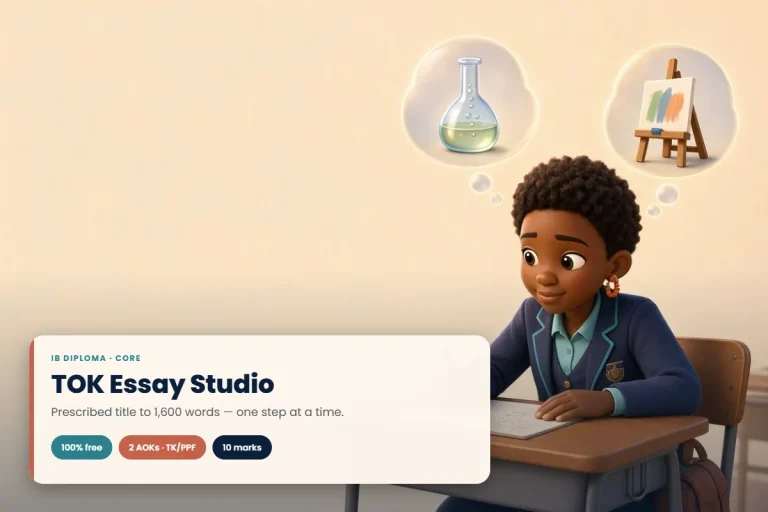
TOK Essay Studio
From a prescribed title to a clear, critical essay: unpack the title, choose areas of knowledge, build claims and counterclaims, and use real examples.
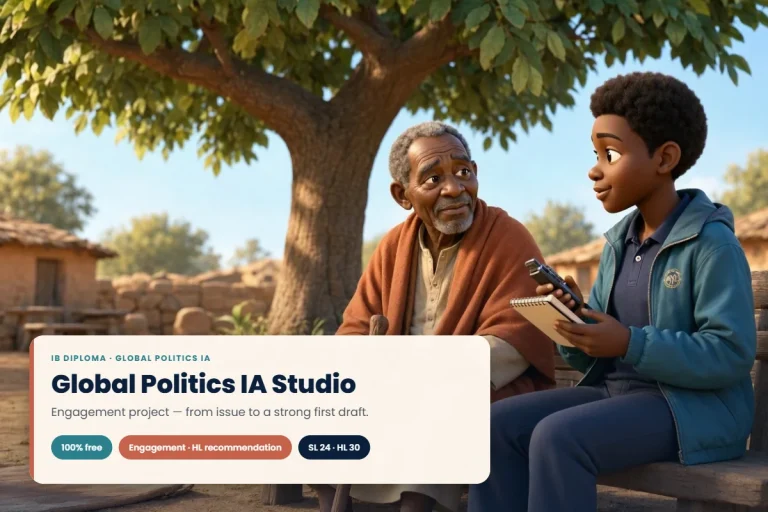
Global Politics IA Studio
The engagement project on the new guide: real engagement with a political issue, your research and your own position. HL students also get the recommendation section.
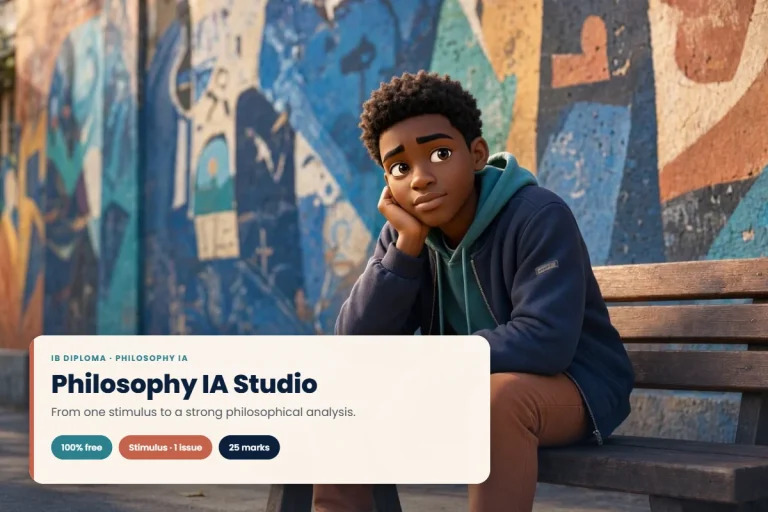
Philosophy IA Studio
A philosophical analysis of a non-philosophical stimulus (a film scene, an advert, an article). Pick the stimulus, name the issue, analyse it and evaluate.

Digital Society IA Studio
The inquiry project on the April 2026 criteria: an inquiry process document, a recorded presentation of up to 10 minutes, and references.
The studios side by side
| Studio | What you produce | Length | Marks |
|---|---|---|---|
| Maths (AA and AI) | Mathematical exploration | 12–20 pages | 20 |
| Sciences (Bio, Chem, Phys) | Scientific investigation | 3,000 words | 24 |
| ESS | Individual investigation | Per the guide | 30 |
| Geography | Fieldwork report | 2,500 words | 25 |
| Business Management | Business research project | 1,800 words | 25 |
| Psychology | Research proposal | 2,200 words | 24 |
| History (to Nov 2027) | Historical investigation | 2,200 words | 25 |
| History 2028 | Historical investigation, new guide | Per the new guide | Per the new guide |
| Economics | Portfolio of 3 commentaries | 800 words each | 45 |
| Extended Essay | Research essay + reflection | 4,000 words | 30 |
| TOK Exhibition | 3 objects + commentary | 950 words | 10 |
| TOK Essay | Essay on a prescribed title | 1,600 words | 10 |
| Global Politics | Engagement project | SL 2,000 · HL 2,400 | SL 24 · HL 30 |
| Philosophy | Analysis of a stimulus | 2,000 words | 25 |
| Digital Society | Inquiry document + presentation | 1,500 words + 10 min | 24 |
Always check the details against the current subject guide your school uses for your exam session. The studios ask for your exam session and follow the matching guide.
For teachers: run a whole class from one dashboard
IA Studio is just as useful for the teacher. Create a class, share the class code, and your students join with your deadlines already set. Students at a school with a Stadira licence get free access all year.
“Needs you today” inbox
Submitted plans waiting for approval and drafts waiting for your one round of feedback, oldest first, with how long each has waited.
Red, amber, green class view
See at a glance who is behind a checkpoint, who has gone quiet for a week and who is on track, with progress bars and next deadlines.
Approval gate
Students cannot move on to data collection or writing until you approve their plan, so weak topics get caught early.
Comment bank and split view
Read the draft on one side and give feedback on the other, with ready-made comments grouped by criterion.
Nudge everyone who is behind
One button sends a friendly email reminder to every flagged student, at most once a day each.
Integrity in view
See each student’s journal, AI-use log and topic, with warnings when two students choose very similar topics or methods.
Students’ names are visible only to their own teacher. Every school runs its IAs at different times of year, so you set your own dates and nothing is fixed to one calendar.
Teacher or DP coordinator? See how IA Studio works for a whole class or department, and request teacher access.
IA Studio for Schools → Set up my free teacher dashboard →Who IA Studio is for
- IB Diploma students at any school, in any country, in Year 12 or Year 13, at SL or HL.
- Students without a strong IA mentor at school, who need structure and examples to work from.
- Strong students aiming for a 7, who want to make sure no criterion is left on the table.
- Teachers and IA supervisors who want every student moving and every checkpoint visible.
- Parents who want to see real progress, not just “I’m working on it”.
Pricing, and how to get it free
Use STADIRA100 at checkout, or tap the 100% OFF box on any studio page. You’ll get a personal access code on screen and by email, and you keep access until 28 February 2027.
Schools that want to run IA Studio for a whole department can read IA Studio for Schools or talk to us on WhatsApp: +267 73 640 907.
How to start today
- Pick your studio from the list above and open its free Start here page.
- Create a free Stadira account or sign in with Google.
- Claim free access with code STADIRA100 (until 28 February 2027), or with your teacher’s class code if your school has a Stadira licence.
- Open IA Studio and set up your course, school and deadlines.
- Do Step 1 tonight. The topic quiz takes about ten minutes, and choosing a topic is the hardest part.
Questions students and teachers ask
Why does the IB have internal assessments at all?
Because a written exam can only show what you remember under time pressure. The IA shows what you can do with a subject: ask a real question, gather evidence, use the subject’s tools and judge the limits of your own work. It is marked by your teacher and moderated by the IB.
How much is the IA worth?
In most Diploma subjects the IA is 20 to 30 percent of the subject grade, and more in a few design-based subjects. Because every subject has one, the IAs together shape a large part of your final score out of 45.
Does IA Studio write my IA for me?
No. IA Studio is AI-free and never writes or suggests your content. It guides your thinking, checks the rules and shows you what each criterion asks for. Every word in your IA is yours.
Is it only for students in Botswana?
No. IA Studio is for IB students at any school, in any country. Most studios have topic cards that work anywhere, and you can filter for “Any country” or “Botswana”.
Does it follow the new IB guides?
Yes. You choose your exam session, and the studio follows the matching guide: for example the new Extended Essay guide (from May 2027), the new Psychology IA (first assessed 2027), a separate History studio for exams from May 2028, and the next Maths guide for later sessions.
Does my teacher have to be on Stadira?
No. You can work alone in self-study mode, with deadlines planned back from your own final due date. If your teacher creates a class, you join with the class code and they can approve your plan and give feedback in the studio.
Can I use it on my phone?
Yes. Every studio works on a phone, with large text you can resize. For long writing sessions a laptop is more comfortable.
What do I get at the end?
A complete draft as a Word or PDF file, set out under the right headings, with a word or page count, an anonymity check and your AI-use declaration, ready for your teacher’s one round of feedback.
Who marks my IA?
Your teacher marks your IA, and the IB moderates it. IA Studio helps you check your own draft against each criterion before it goes in, so you know where you stand.
How much does it cost?
P499 per studio for 12 months. With code STADIRA100, every studio is free until 28 February 2027. Students at a school with a Stadira licence get free access all year.
Your IA starts with one good topic
Open your studio, take the topic quiz and leave tonight with a topic you can work on.
IA Studio is an independent study tool from Stadira Training Institute. It is not produced or endorsed by the International Baccalaureate Organization. Always follow your school’s IA calendar and your teacher’s instructions.