
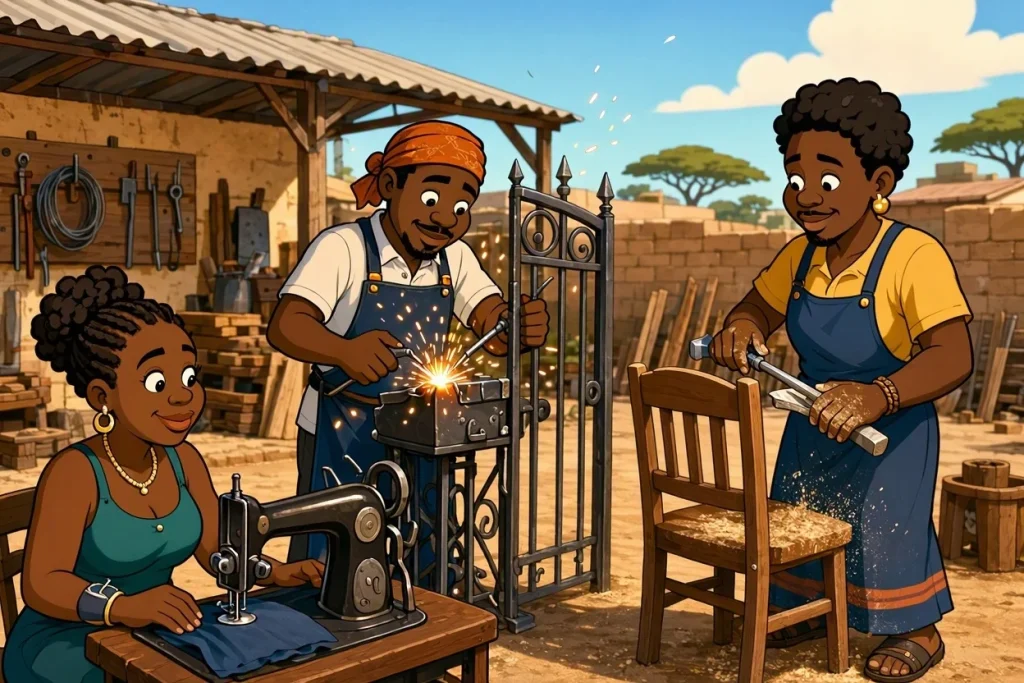
Walk through the bus rank in Gaborone, the station mall in Francistown or the roadside stalls of Molepolole and you are looking at one of Botswana’s most underrated economic assets: the informal market. The vendor selling airtime and sweets, the mechanic fixing cars under a tree, the seamstress working from her veranda, the young man grilling boerewors outside the mall — none of them appear in a corporate payroll, yet together they feed families, school children and keep money moving through every village and town. Across Africa, countries that stopped treating these traders as a problem and started treating them as an engine have discovered something remarkable: the informal sector is the continent’s biggest job creator. No country proves it better than Kenya.
Botswana’s jobs question — and where the answer is hiding

The numbers from Statistics Botswana frame our challenge plainly: national unemployment stood at 27.6% in the Q1 2024 Quarterly Multi-Topic Survey, and the latest published youth unemployment rate is 38.2% (2024). The formal economy — government, mines, banks, large retailers — simply cannot absorb every school leaver and graduate. It was never going to. This is not a Botswana failure; it is the reality of every developing economy on the continent.
The International Labour Organization estimates that around 85% of all employment in sub-Saharan Africa is informal. That is not a footnote to Africa’s economy — it is Africa’s economy. The question facing Botswana is not whether the informal sector matters, but whether we will organise, equip and grow it deliberately, the way the continent’s most successful examples have done.
Kenya: the jua kali economy that carries a nation
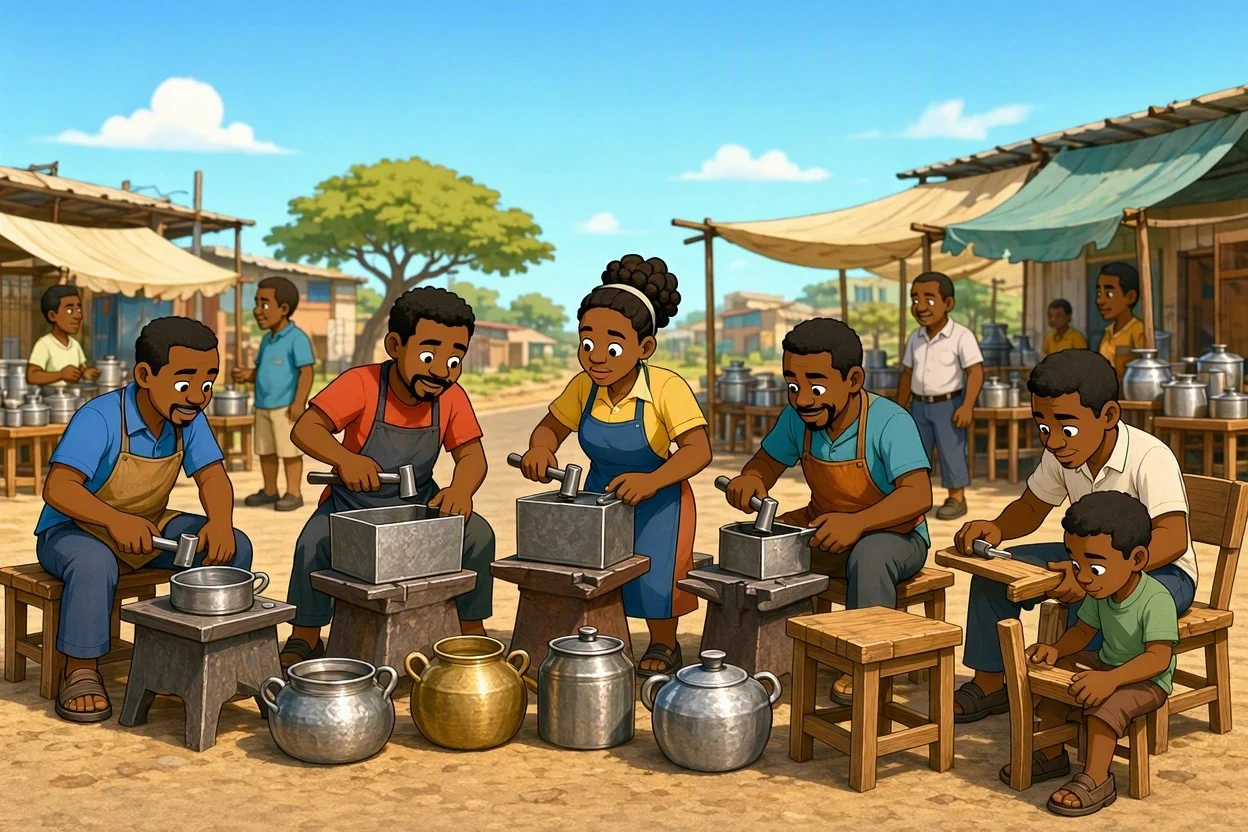
Jua kali is Swahili for “hot sun” — the artisans, welders, tailors, mechanics and traders who work in the open air without formal premises. What began as a survival economy is today the backbone of East Africa’s largest economy. In fact, the very term “informal sector” was coined in a 1972 ILO study of Kenya — the world literally learned the concept from Nairobi’s workshops.
The latest figures from the Kenya National Bureau of Statistics are staggering:
- The informal sector employs about 18.1 million Kenyans — 83.8% of total employment — against roughly 3.3 million formal wage jobs.
- Of the 822,100 new jobs Kenya created in 2025, about 87% came from the informal sector.
- Informal manufacturing alone — the welders and fabricators of jua kali — employs around 3.6 million people, more than Botswana’s entire population.
How did Kenya get here? Not by accident. Over three decades, Kenya made deliberate choices that turned hot-sun hustle into a development engine:
- Clusters, not scattered stalls. Nairobi’s Kamukunji and Gikomba markets concentrate thousands of artisans in one place. Clustering creates shared customers, shared suppliers, apprenticeships and specialisation — a welder in Kamukunji can learn, buy steel, and sell, all within one square kilometre.
- Financial inclusion through mobile money. M-Pesa gave every trader a bank in their pocket. Informal businesses that could never open a corporate account now receive payments, save, borrow and even contribute to pensions by phone. Jua kali associations have used mobile money to enrol hundreds of thousands of informal workers into retirement schemes.
- Credit designed for the hustle. Kenya’s Hustler Fund lends amounts as small as KES 500 (about P50) at roughly 8% annual interest — recognising that a trader’s first constraint is often stock money, not a business plan.
- Going digital. Gikomba fabricators take orders on WhatsApp; platforms like Kuza Biashara help artisans market their skills and get paid digitally. The informal sector did not wait for formality to modernise.
- Voice and recognition. Jua kali associations negotiate with government, secure work sites, and give the sector a seat at the policy table.
The result: a sector once dismissed as “the people who could not find real jobs” now supplies furniture to schools, parts to industry and skills to millions — and creates nearly nine in every ten new Kenyan jobs.
It is not only Kenya
Ghana turned an informal repair yard into an industrial institution. Suame Magazine in Kumasi is one of Africa’s largest artisan clusters — by many estimates tens of thousands of mechanics, machinists and metalworkers in thousands of workshops, training generations of apprentices and servicing vehicles from across West Africa. Ghana has also pioneered extending pension and social protection schemes to informal workers, proving that “informal” need not mean unprotected.
Nigeria’s informal clusters have become industries in their own right. Lagos’s Computer Village grew from street traders into one of Africa’s largest ICT markets, while the shoemakers of Aba in Abia State produce, by some estimates, around a million pairs of shoes a week — supplying markets across West and Central Africa from workshops that began entirely informally.
Rwanda shows the other half of the journey: making formality easy. Business registration was streamlined until it takes hours rather than weeks, cooperatives were promoted, and financial inclusion was pushed aggressively — so informal traders graduate into the formal economy because it is worth it, not because they are forced. Rwanda measurably shrank its informal share not by punishing traders but by lowering the wall between the two economies.
The common thread across all four countries: they invested in the informal sector instead of ignoring it — sites and shelter, micro-credit, mobile payments, skills, and a path to formality that rewards the trader who takes it.
What this means for Botswana
Botswana is better placed than almost any country on the continent to run this playbook — smaller population, stronger institutions, better infrastructure. And the foundations are already being laid. Government has recognised the informal sector’s potential in line with Vision 2036; the Chema Chema Fund, launched with P500 million in seed capital, exists precisely to give informal traders and micro-enterprises affordable, short-term finance — with LEA handling registration and training and CEDA disbursing the funds. Notably, more than half of Botswana’s informal businesses are women-owned — meaning investment in this sector is also direct investment in women’s economic power.
The Kenyan lesson for policy is clear: dedicated market spaces and artisan clusters rather than scattered, insecure trading spots; payment and credit systems that reach a phone in Tsabong as easily as an office in the CBD; skills programmes built for traders, not just corporates; and a registration path simple enough that formalising feels like a promotion, not a punishment.
But the lesson for citizens matters even more. Kenya’s jua kali economy was not built by government — it was built by millions of ordinary people who refused to wait for employment and created it instead. Every Kenyan welder under the hot sun made a decision Botswana’s young people face today: start where you are, with what you have.
If you are hustling in Botswana, take heart — and take these steps

- Your hustle is not a fallback; it is the frontline of the economy. Nearly nine in ten new African jobs are created by people exactly like you.
- Keep records from day one. The single biggest difference between traders who get Chema Chema, CEDA or bank support and those who do not is written numbers — sales, costs, profit. A funder cannot approve what they cannot verify.
- Learn the money skills. Costing, pricing and cash-flow discipline are what turned Kenyan artisans into manufacturers. They are trainable skills, not talents.
- Market digitally. WhatsApp, Facebook and mobile payments did for Kenya’s traders what shop frontage does for retailers — for free. A trader with a phone has a national storefront.
- Organise. Join or form a traders’ or artisans’ association. Kenya’s jua kali won work sites, pensions and policy influence because they spoke with one voice.
- Formalise when it pays. Registration opens doors — tenders, funding, contracts. Use LEA to make the step, and time it so formality grows your business rather than taxing your survival.
Where training fits in

Skills are the bridge in every success story above — the apprentice systems of Suame Magazine, the digital skills of Gikomba, the financial discipline behind every Hustler Fund repayment. Stadira’s practical short courses were built for exactly this journey: Entrepreneurship for costing, records and a fundable plan; Digital Marketing to turn your phone into your storefront; Customer Experience to keep the customers you win; and Project Management & M&E as your operation grows. Employers and cooperatives can sponsor members through the HRDC training levy.
Key takeaways
- Around 85% of sub-Saharan Africa’s employment is informal (ILO) — the informal market is the continent’s real jobs engine.
- Kenya’s jua kali sector employs 18.1 million people (83.8% of all employment) and produced about 87% of the country’s new jobs in 2025 (KNBS).
- Ghana, Nigeria and Rwanda show the same pattern: clusters, micro-credit, mobile money, skills and easy registration turn hustle into industry.
- Botswana has the tools — Chema Chema (P500m), CEDA, LEA — and over half of our informal businesses are women-owned.
- For the individual trader, the multipliers are trainable: record keeping, costing, digital marketing and organisation.
Sources & further reading
We believe readers deserve to see where our claims come from. Figures are as published by these official sources at the time of writing (July 2026) — explore the data yourself:
- Kenya National Bureau of Statistics — Economic Survey (employment and informal sector data)
- International Labour Organization — informal economy in Africa
- Statistics Botswana — quarterly labour force and employment surveys
- CEDA — Chema Chema Fund and citizen enterprise funding
- LEA — informal sector registration, training and incubation
- Government of Botswana — Vision 2036 and citizen economic empowerment
Ready to turn your hustle into an enterprise? Explore our short courses, message us on WhatsApp, or email [email protected]. Stadira Training Institute, Gaborone — courses aligned to HRDC priority skills.


This is a great piece