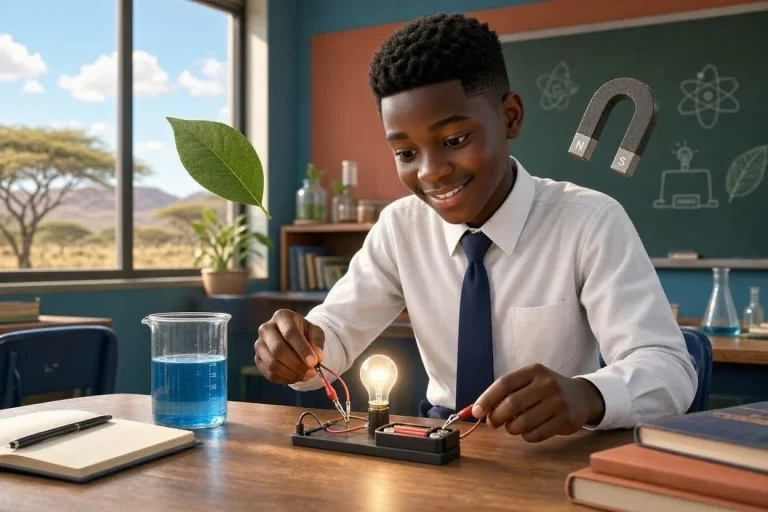

MYP Sciences on Stadira now does more than teach the lessons. Every course, from MYP Year 1 to Biology, Chemistry and Physics 4–5, has a study system around it: a plan with a countdown to your exam, a map of what you know by unit and by criterion, a ten-question review every day, a practice test for every unit, a gym for the planning and data skills, and in every lesson the mistakes IB examiners see again and again. This guide shows students, parents, teachers and tutors how to use it.
Six courses, MYP Year 1 to the eAssessment
- MYP Sciences Year 1, Year 2 and Year 3: biology, chemistry and physics together, as the IB’s own model courses teach them, with a virtual experiment in almost every lesson and a criterion A–D test at the end of each unit.
- MYP Biology 4–5, Chemistry 4–5 and Physics 4–5: one course per subject for the last two years, written to the eAssessment topic lists, with a two-hour exam at the end of each unit, an eAssessment bridge unit and four full mock exams.
- MYP Sciences e-Assessment Practice: real on-screen papers from May 2021 to May 2025.
1. Start here: your plan, your map, your Daily 10
The first lesson of every course is now Start here. Open it before anything else.
- The diagnostic: two questions from every unit, about ten minutes. It shows which units you already know and which need the most time. Wrong answers are fine; that is the point.
- Your study plan: enter your exam date (1 November is filled in for you, change it if your exam is in May) and the hours a week you can give. The plan works out how many lessons a week you need, warns you if the hours are not enough, keeps the last weeks free for revision and lists this week’s lessons.
- Your mastery map: every unit, coloured from “Needs work” to “Mastered”, and your level for each MYP criterion — A from your quizzes and reviews, B, C and D from the unit tests you or your teacher mark.
- Daily 10: ten questions from the lessons you have reached, chosen so that what you are about to forget comes back just in time. Questions you get wrong return tomorrow; questions you get right come back later and later. Ten minutes a day keeps a whole year of science fresh for the exam.
2. A practice test for every unit
Each of the 59 units has a practice test of 15 questions: knowledge questions, questions set in the unit’s own investigations, and calculations where you type the number. Every answer comes with a full explanation, and calculations are worked one step per line — formula, substitution, each step, answer with its unit. Take the test when you finish a unit and again before your school test. Your best score is kept.
3. What the examiners see — in every lesson
We read 26 IB MYP Sciences subject reports, May 2023 to May 2026, and turned the mistakes examiners report again and again into cards inside the lessons where they happen. Each card shows an answer that loses the mark, the version that earns the mark, and why. For example:
- “same equipment” is never accepted as a control variable — name what is kept the same and how;
- a dependent variable must be read from an instrument — “rate” and “growth” are calculated, not measured;
- a conclusion must quote numbers from the graph, not just say “it goes up”;
- convert milliseconds, grams and centimetres before you calculate, and round to the precision of the data.
4. The Skills gym for criteria B and C
Half of the eAssessment marks are for designing investigations and processing data. The Skills gym has 18 exercises that train exactly what the examiners reward: sorting variables, writing a research question and a hypothesis with a scientific “because”, choosing the right instrument, building a complete method (five values, three repeats, a mean), drawing results tables, plotting graphs on a real grid, calculating means, percentage change and gradients with units, telling improvements from extensions, and naming sources of error that earn credit. Every step shows a worked answer.
5. Lessons that are easier to study
- Step by step: long lessons open one section at a time, with Back and Next, or all at once if you prefer.
- Text size from A− to A++, remembered for every lesson.
- Listen: the lesson read aloud, section by section.
- Tap a key term for its meaning, and a full searchable glossary of every key term in the course on the Start here page.
- “Did you get it?” after each check-point question, so your map knows which ideas need another look.
For teachers and tutors
Teacher access is free at stadira.com/myp-sciences-teachers. Make a class, give your students its six-letter code (they type it on Start here), and see:
- every student’s lessons done, Check-yourself average, Daily 10 streak and last visit, and a colour for every unit;
- who is behind their own study plan;
- work you set — a whole unit, one lesson or a unit test — with due dates and who has done it;
- a box to type in the criterion levels (0–8) you give each student for each unit test, shown next to the student’s own levels;
- a one-page report for each student, to print or share on WhatsApp, and a CSV of the class.
Open any lesson with ?teach=1 at the end of its address to project it in class: big text, one step at a time, answers hidden until you reveal them. A class code only links a student to your class; it does not enrol anyone or give access to a course.
For schools and tutoring centres
A head of department can create the school or centre on the teacher page and give its code to colleagues. The owner then sees every class in the school, read-only, alongside their own. For a school quote, message us on WhatsApp with the number of learners and the courses you need.
How to start
- Choose your course on the School page: Years 1–3 P999 a year, Biology, Chemistry or Physics 4–5 P1,999 a year, or all six in the Sciences bundle.
- Until 30 April 2027, enter the code STADIRA100 at checkout for free access.
- Open Start here, take the diagnostic, set your plan, and do your first Daily 10.
Ten minutes a day, one unit at a time
Daily 10 every day, a lesson or two each week from your plan, and the unit practice test before every school test. Your map will show you the rest.
Courses written and developed by the Stadira teaching team. IB, International Baccalaureate and MYP are trademarks of the International Baccalaureate Organization; Stadira is not affiliated with or endorsed by the IB.