
A Levels or IB Diploma? Three subjects deep, or six subjects wide.
Both are respected by universities in many countries. Both take two years. But they suit very different students, and the wrong choice can make those two years much harder than they need to be. Here is how to choose with your eyes open.

After Form 5 or Year 11, many families face the same question: Cambridge International AS & A Levels or the International Baccalaureate Diploma Programme (IB DP)? Friends say one is “harder”, relatives say the other is “better for abroad”, and the school brochure says both are excellent. This guide puts the two side by side, honestly, so you can decide based on the student in front of you.
The big difference in one picture
📚 Cambridge A Levels: go deep
- You choose your own subjects, usually 3 or 4
- No compulsory subjects: drop maths, or drop languages, if you want
- Each subject is studied in great depth, about 360 teaching hours
- Your grade comes mainly from written exams
🌐 IB Diploma: go wide
- Six subjects from six groups, three or four at Higher Level
- Everyone takes a language, a second language, maths, a science and a humanities subject
- Plus the core: Theory of Knowledge, a 4,000-word Extended Essay, and CAS
- Every subject includes coursework marked partly by your teacher

What each programme actually is
📚Cambridge International AS & A Levels
- Run by: Cambridge University Press & Assessment, the same board as IGCSE
- Length: AS Level is usually one year (about 180 hours); the full A Level is usually two (about 360 hours)
- Routes: take AS in Year 12 and finish the A Level in Year 13, or sit all papers at the end
- Grades: A*, A, B, C, D, E at A Level; a to e at AS
- Exam sessions: June and November
🌐International Baccalaureate Diploma
- Run by: the International Baccalaureate, the same organisation as the MYP
- Length: two years; Higher Level subjects about 240 hours, Standard Level about 150
- Grades: 1 to 7 per subject, plus up to 3 points for TOK and the Extended Essay
- Pass: at least 24 points out of 45, plus CAS and a set of conditions (see the FAQ)
- Exam sessions: May for most schools, November for some
Side by side: the full comparison
| Cambridge A Levels | IB Diploma | |
|---|---|---|
| Number of subjects | Usually 3 or 4 (sometimes plus AS subjects) | 6, from six subject groups |
| Compulsory subjects | None | Maths, two languages, a science, a humanities subject |
| Depth or breadth | Depth: specialise early | Breadth: keep many doors open |
| Extra requirements | None outside your subjects | Theory of Knowledge, 4,000-word Extended Essay, CAS |
| How you are assessed | Mostly final written exams; coursework in some subjects; practical exams in the sciences | Final exams plus an internal assessment in every subject (usually 20–30% of the grade) |
| Grades | A* to E per subject | 1 to 7 per subject, 45 points maximum |
| Can you drop a subject? | Yes, e.g. take 4 at AS and continue 3 to A Level | No, all six run for two years (levels can sometimes change early) |
| Retakes | Possible at the next exam session | Possible in the next session, but less common |
| If one subject goes badly | The others still stand on their own | It can pull down the total, or cost the Diploma |
| Weekly feel | Fewer subjects, heavier content in each | Many deadlines at once, especially in Year 13 |
Good to know: the “harder” question has no single answer. A student who loves physics and maths may find three A Levels easier than six IB subjects. A student who is good at many things and writes well may find the IB more comfortable than three very deep A Levels.
How the exams actually work
Both programmes end with written exams marked by external examiners, but the way the marks are built up is very different. Here is what a student actually sits.
📝Cambridge A Levels
- Each subject has its own set of papers, usually 3 to 5, mostly 1 to 2 hours each
- AS papers can be sat at the end of Year 12 and count for half of the A Level
- Grades: A* to E at A Level, a to e at AS. The A* exists only at full A Level
- Sciences include a timed practical exam and a planning and analysis paper
- Only a few subjects, such as Art and Design and Global Perspectives and Research, include coursework
- You can resit a paper in the next exam series
🧾IB Diploma
- Each subject has 2 or 3 external papers plus an internal assessment (IA)
- The IA is coursework marked by your teacher and checked by the IB, usually 20–30% of the grade
- Each subject is graded 1 to 7; grade boundaries are set each session
- Theory of Knowledge: a 1,600-word essay (two thirds) and an exhibition (one third)
- Extended Essay: 4,000 words, marked externally, graded A to E
- CAS: 18 months of creativity, activity and service; not graded, but required
Example 1 · Cambridge A Level Mathematics (9709)
Four papers for the full A Level. Paper 1 and Paper 3 are compulsory; the other two come from Mechanics and Statistics.
| Paper | Length | Marks | Share of A Level |
|---|---|---|---|
| Paper 1 · Pure Mathematics 1 | 1 h 50 | 75 | 30% |
| Paper 3 · Pure Mathematics 3 | 1 h 50 | 75 | 30% |
| Paper 4 · Mechanics, or Paper 5 · Probability & Statistics 1 | 1 h 15 | 50 | 20% |
| Paper 5 · Probability & Statistics 1, or Paper 6 · Probability & Statistics 2 | 1 h 15 | 50 | 20% |
Example 2 · Cambridge A Level Physics (9702)
Five papers: three from the AS year and two from the A Level year.
| Paper | Length | Marks | Share of A Level |
|---|---|---|---|
| Paper 1 · Multiple choice (AS content) | 1 h 15 | 40 | 15.5% |
| Paper 2 · AS structured questions | 1 h 15 | 60 | 23% |
| Paper 3 · Advanced practical skills (lab exam) | 2 h | 40 | 11.5% |
| Paper 4 · A Level structured questions | 2 h | 100 | 38.5% |
| Paper 5 · Planning, analysis and evaluation | 1 h 15 | 30 | 11.5% |
Example 3 · How IB Diploma subjects are assessed
Every subject mixes final exams with coursework. A few typical examples:
| Subject or core part | Final exams | Coursework (IA) |
|---|---|---|
| Maths AA or AI · SL | Paper 1 and Paper 2, 1 h 30 each (80%) | Maths exploration (20%) |
| Maths AA or AI · HL | Papers 1, 2 and 3, about 5 hours in total (80%) | Maths exploration (20%) |
| Biology, Chemistry, Physics · SL | Paper 1 and Paper 2, 3 hours in total (80%) | Scientific investigation (20%) |
| Biology, Chemistry, Physics · HL | Paper 1 (2 h) and Paper 2 (2 h 30) (80%) | Scientific investigation (20%) |
| Theory of Knowledge | 1,600-word essay on a set title (two thirds) | Exhibition of three objects, 950 words (one third) |
| Extended Essay | 4,000-word independent research essay, marked externally, graded A to E | |
The core points: Theory of Knowledge and the Extended Essay are each graded A to E and combined into 0 to 3 extra points. Two As, or an A and a B, earn the full 3 points. An E in either one means no Diploma, whatever the subject grades.
The exam calendar
IB: most schools sit the May session, with exams from late April through May and results in early July (6 July in 2026). Some schools use the November session, with results in early January.
Cambridge: the main June series runs from late April or May to mid-June, with results in mid-August (12 August in 2025). There is also a November series, with results in mid-January.
World results: the last five years
How many students actually succeed? These are the figures published by the two exam boards for the main exam session of each year, 2022 to 2026.
IB Diploma: results for all candidates, May session
| Year | Diploma candidates | Pass rate (Diploma awarded) | Average score (out of 45) | Scored 40 to 45 |
|---|---|---|---|---|
| 2022 | 107,804 | 86.1% | 32.0 | 14.7% |
| 2023 | 110,663 | 80.0% | 30.2 | 8.9% |
| 2024 | 116,449 | 80.5% | 30.3 | 9.3% |
| 2025 | 128,398 | 81.9% | 30.6 | 9.8% |
| 2026 (provisional) | not yet published | 82.6% | 30.9 | not yet published |
| Five-year average | 82.2% | 30.8 | 10.7% (2022–25) |
Reading the IB numbers: 2022 results were still adjusted for the pandemic, so they run higher. From 2023 grading returned to normal and the average settled at around 30 points. The 2026 figures are provisional and include students in parts of the Middle East who were graded without exams because of the regional conflict. In May 2026, 209,607 DP and CP students received results, and the Diploma is now offered in more than 3,900 schools across 159 countries.
Cambridge International A Level: pass rates for all candidates, June series
Cambridge does not publish one overall pass rate. It publishes results subject by subject. This table shows the percentage of A Level candidates who achieved A* to E in popular subjects.
| Subject | 2022 | 2023 | 2024 | 2025 | 2026 | 5-year average |
|---|---|---|---|---|---|---|
| Further Mathematics | 96.4% | 95.0% | 94.2% | 96.0% | 95.7% | 95.5% |
| Physics | 92.9% | 92.3% | 92.0% | 92.0% | 92.7% | 92.4% |
| Mathematics | 92.7% | 92.1% | 91.7% | 92.0% | 93.1% | 92.3% |
| Chemistry | 93.0% | 91.3% | 91.0% | 91.5% | 92.6% | 91.9% |
| Biology | 91.6% | 89.0% | 88.6% | 90.3% | 91.2% | 90.1% |
| Economics | 91.1% | 88.4% | 87.0% | 87.6% | 87.8% | 88.4% |
| Computer Science | 89.4% | 85.4% | 87.9% | 88.5% | 90.1% | 88.3% |
| Accounting | 86.4% | 84.9% | 85.1% | 86.5% | 85.7% | 85.7% |
| Psychology | 88.7% | 84.1% | 82.6% | 82.4% | 83.8% | 84.3% |
| Business | 87.4% | 85.1% | 79.6% | 80.4% | 80.7% | 82.6% |
| English Language | 84.2% | 79.9% | 71.6% | 67.3% | 66.7% | 73.9% |
How hard is the top grade?
Five-year world averages (June 2022 to June 2026): the share of A Level candidates achieving an A*, and an A or A*.
| Subject | A* | A* or A | In plain words |
|---|---|---|---|
| Further Mathematics | 26.3% | 58.0% | Over half get an A or A*, because mostly strong mathematicians take it |
| Chemistry | 17.0% | 37.5% | About 1 in 6 get an A* |
| Mathematics | 16.8% | 38.2% | About 1 in 6 get an A* |
| Physics | 14.3% | 33.9% | About 1 in 7 get an A* |
| Biology | 14.3% | 34.0% | About 1 in 7 get an A* |
| Economics | 12.8% | 30.6% | About 1 in 8 get an A* |
| Business | 6.9% | 17.2% | About 1 in 14 get an A* |
| English Language | 0.4% | 2.2% | Top grades are very rare |
About 1 in 5 IB students misses the Diploma
The world IB pass rate has stayed between 80% and 83% since 2023. A student can miss out by falling short on just one condition, such as too few Higher Level points or an E in the core. They still receive a result for every subject.
Passing an A Level is common; an A* is not
Around 9 in 10 candidates pass Maths, Physics, Chemistry and Biology, but only about 1 in 7 earns an A*. Top universities ask for A and A* grades, so the real challenge is the top of the scale, not the pass mark.
Compare carefully
The two pass rates measure different things. The IB rate is for the whole Diploma, with all its conditions. A Level rates are per subject and count only students who sat the full A Level. A strong student does well in either; the averages simply show where the pressure points are.
The class of 2026 is big
Nearly 368,000 learners in 3,492 schools received Cambridge AS and A Level results in June 2026. In 2025 the figure was 354,000 students in 3,367 schools across 129 countries, with more than 700,000 subject entries.
What universities say
Both qualifications are accepted by universities in the UK, the USA, Canada, Europe, Australia, South Africa and Botswana. What changes is how the offer is written. Here is a real example and what it means.
| Imperial College London · Mechanical Engineering | With A Levels | With the IB |
|---|---|---|
| Typical offer | A*A*A to A*AAA | 40 points |
| Maths | A* in Mathematics | 6 in Mathematics at Higher Level (AA preferred, AI accepted) |
| Physics | A* or A in Physics | 6 in Physics at Higher Level |
United Kingdom
A Levels are the home qualification, so offers are written in grades (for example AAA). IB offers are written as a total plus Higher Level scores (for example 36 with 6, 6, 5 at HL). The UK equivalence tables listed by UCAS put a 7 at Higher Level level with an A* at A Level. The University of Manchester’s page for Botswana says A Level students can be considered directly for bachelor’s degrees, while BGCSE holders first need a foundation programme.
USA and Canada
Both are welcomed. Universities look at your whole school record, essays and activities, and many give credit for strong A Level or IB Higher Level results. The IB’s CAS and Extended Essay give students plenty to write about in applications; A Level students should build activities alongside their studies.
South Africa
Students need an exemption from the Matriculation Board. Cambridge students usually qualify with 3 A Levels plus 1 IGCSE at grade C, or 2 A Levels plus 3 IGCSEs, with subjects from set groups, and most routes need two languages. Your IGCSE languages can count, so plan this before Year 12. The full IB Diploma is generally accepted; always check the Matriculation Board’s current rules.
Botswana
The University of Botswana considers both A Level and IB Diploma holders. For example, its medicine page lists both for direct entry into the MBBS programme, with Chemistry and other science requirements. Check the exact programme page each year.

Which student fits which road?
These are typical profiles, not rules. Most students are a mix, so look for the one that sounds most like your child, or most like you.
EXAMPLE · The focused future engineer
- Loves maths and physics, finds essays a chore
- Knows the degree they want
- Leans A Levels: Maths, Further Maths, Physics, plus Chemistry or Computer Science
EXAMPLE · The all-rounder
- Good at sciences, languages and humanities
- Not sure yet between law, medicine and economics
- Leans IB: keeps every door open while building strong habits
EXAMPLE · The future medic
- Strong in Biology and Chemistry, organised, steady
- Either road works: three or four science A Levels, or IB with Chemistry and Biology at HL
- Decide on: school quality and which you will score higher in
EXAMPLE · The athlete or artist
- Spends many hours on sport, music or art at a high level
- Needs time and a lighter weekly spread
- Leans A Levels: fewer subjects, no core deadlines, room to train
A word on maths
Maths is where the two roads differ most, and it matters for science, engineering, economics and computing degrees.
📐A Level route
- Mathematics (9709) covers pure maths, mechanics and statistics
- Further Mathematics (9231) is a second, deeper maths A Level
- Top UK maths, engineering and physics courses often prefer or expect Further Maths
- You can also drop maths completely if your degree does not need it
📊IB route
- Maths is compulsory: Analysis and Approaches or Applications and Interpretation
- Each at Standard or Higher Level
- AA HL is the usual choice for engineering and physics
- Read our full guide: AA or AI? SL or HL?
1. I already know roughly which degree I want.
2. I would rather write exams than long essays.
3. There are subjects I would happily never study again.
4. I like going very deep into a few subjects.
5. I work best with fewer deadlines.
What does my score mean?
4 or 5 true: A Levels probably fit your way of working.
2 or 3 true: either road can work. Let your degree requirements and the quality of the school decide.
0 or 1 true: you are likely an all-rounder who will enjoy the IB’s breadth and its core.
Coming from IGCSE, BGCSE or MYP?
From Cambridge IGCSE
A Levels feel like a natural next step: same board, same style of papers. The IB is very open to IGCSE students too, but expect to build essay writing, independent research and coursework habits quickly.
From BGCSE
Both roads are open. The biggest jump is usually in maths and English: check that you are comfortable with Extended-level algebra and with longer written answers. Read our IGCSE or BGCSE guide for the gaps that matter.
From the IB MYP
The Diploma will feel familiar: criteria-based marking, inquiry projects, and the Personal Project is good practice for the Extended Essay. A Levels are fine too, but get used to timed, exam-only papers. See the MYP e-Assessment explained.
The bridging plan for everyone
Use the holiday before Year 12 to fix hand algebra, read widely in your strongest subject, and look up the entry page of three degrees you might apply for.
🧭 A Levels or IB? Find your road: eight questions
1. Do you know what you want to study at university?
2. How many subjects do you want to keep studying?
3. How do you show what you know best?
4. A 4,000-word research essay sounds…
5. Your ideal week looks like…
6. Where do you hope to study?
7. Maths for you is…
8. Outside lessons, you…
Myth or fact?
Ten questions to ask a school before you enrol
- Which A Level subjects or IB subjects and levels do you actually run, and which clash on the timetable?
- What were your results last year, and how many students sat each subject?
- How many of your teachers have taught and examined this programme before?
- Do you offer Further Maths (A Level) or AA Higher Level (IB)?
- How do you support the Extended Essay and CAS, or university applications for A Level students?
- Can my child change subjects or levels in the first term, and until when?
- Where did last year’s leavers go to university?
- What is the full two-year cost, including exam entry fees?
- Which exam session do you use: May/June or November?
- How do you help a student who falls behind?
There is no winner between A Levels and the IB. There is only a better fit for each student. Choose the road your child will enjoy and score well in, at a school that teaches it well, with subjects that match the degrees they are considering. A strong A Level student and a strong IB student end up at the same universities.
Prof. Kitso · The Stadira Study Desk
Decide in one evening
👨👩👧For parents
- Ask your child to name three degrees they might apply for
- Open each degree’s entry page together and note the subjects it asks for
- Ask the school the ten questions above
- Choose for fit and teaching quality, not for prestige
🎒For students
- Do the eight-question tool above honestly
- List the subjects you would happily drop, and the ones you would never drop
- Talk to a student who is already in each programme
- Remember: you will study this for two years, so choose what you can keep enjoying
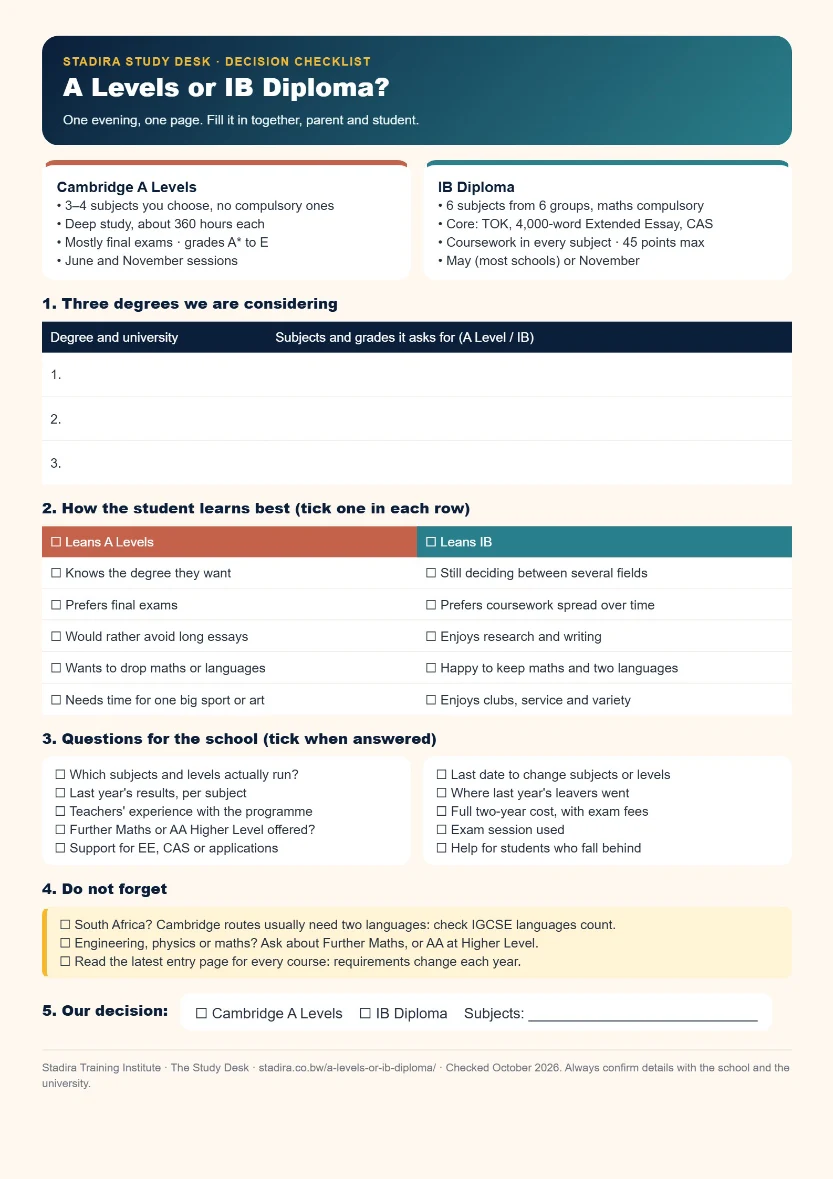
A Levels or IB? The decision checklist
One page for the kitchen table: the key differences, your degree requirements, the school questions and a final tick-box decision.
Download the PDF (1 page)Questions parents and students ask
Is the IB Diploma harder than A Levels?
It is different rather than harder. The IB has more subjects and more deadlines; A Levels go deeper in fewer subjects. Which feels harder depends on the student.
What are the conditions for passing the IB Diploma?
At least 24 points, CAS completed, no grade 1 in any subject, no E in Theory of Knowledge or the Extended Essay, no more than two grade 2s, no more than three grades of 3 or below, at least 12 points at Higher Level and at least 9 at Standard Level.
How many A Levels do universities want?
Most UK offers are based on three A Levels. Some competitive courses ask for or welcome a fourth, such as Further Maths for maths and engineering. Check each course page.
Can I study in South Africa with A Levels?
Yes. Cambridge students usually need 3 A Levels plus 1 IGCSE at grade C, or 2 A Levels plus 3 IGCSEs, from set subject groups, and most routes need two languages. Check the Matriculation Board’s current rules before choosing subjects.
Can a BGCSE student go into the IB or A Levels?
Yes, if the school accepts them. Plan to close gaps in maths and English writing during the holiday before Year 12.
Can I switch from the IB to A Levels after starting?
Sometimes, in the first weeks or months, if the school runs both programmes and the subjects fit the timetable. Switching later is hard, so choose carefully at the start.
What is the IB Diploma pass rate?
Between 80% and 83% in every May session from 2023 to 2026, with a five-year average of about 82% and an average score of about 31 points out of 45.
What percentage of students pass A Levels?
Cambridge publishes results per subject. In June 2022 to 2026, about 92% passed Mathematics and Physics with A* to E, about 90% passed Biology, and about 74% passed English Language. Around 1 in 7 science and maths candidates earned an A*.
Get ready for Year 12, whichever road you choose
Strong foundations in maths make both roads easier. Stadira’s self-study courses help students close gaps before Year 12 and keep up once they start. Built, developed and assessed by qualified teachers.
The Stadira teaching team
This guide was written by practising IB and IGCSE teachers with over 15 years in international schools, teaching IB DP, MYP, IGCSE and BGCSE.
Prof. Kitso, pictured, is our cartoon study guide. You will meet him in the tip boxes and in our lessons.
Checked October 2026 against UCAS qualification information for Cambridge International A Levels and the IB Diploma, Cambridge International’s South Africa recognition guide, the University of Manchester’s Botswana entry page, the University of Botswana and Imperial College London course listings, Cambridge International’s AS and A Level results statistics (June 2022 to June 2026), Cambridge syllabuses 9709 and 9702, the IB’s DP statistical bulletins (May 2022 to May 2025) and IB results announcements for May 2025 and May 2026. Pass-rate figures are for the main exam session each year. University requirements change every year: always read the latest entry page for each course you apply to.