Two certificates. Two different journeys. Choose with your eyes open.
Most families pick between IGCSE and BGCSE by default: whatever the school offers. This guide shows what each one really leads to, so the choice is yours and not an accident.

Ask ten parents in Gaborone which is “better”, IGCSE or BGCSE, and you will get ten confident answers. Most of them miss the point. The real question is not which certificate is better. It is where your child wants to be in five years, and which road gets them there with the fewest detours.
The two certificates at a glance
Both are school-leaving qualifications taken at about 16 to 18, after Form 5 or Year 11. Both test a range of subjects, and in maths both split into Core and Extended. The differences are in who sets them, when you can sit them, and where they open doors.
| BGCSE | Cambridge IGCSE | |
|---|---|---|
| Who sets it | Botswana Examinations Council (BEC) | Cambridge International, UK |
| Where it is taught | Government schools and many private schools in Botswana | Private and international schools, in more than 150 countries |
| When you write it | Once a year, at the end of Form 5 (October to November) | Two main series a year: May to June, and October to November |
| Grades | A* to G | A* to G (some subjects use 9 to 1) |
| Maths syllabus | 0563 Mathematics, Core or Extended | 0580 Mathematics, Core or Extended |
| What usually comes next | University of Botswana, BIUST, colleges and sponsored programmes at home | A Levels or the IB Diploma for two more years, then university anywhere |

The road map nobody draws for you
This is the picture we wish every family saw in Form 1. Follow your child’s road to the end before you decide.
Look at the right-hand end of each road. That is where the surprises are.
Five eye-openers most families learn too late
An IGCSE on its own is not a ticket to a university abroad
Many parents pay international-school fees believing IGCSE is the “international” certificate that opens foreign universities. In most countries it is not the final step. UK, European and many other universities expect A Levels, the IB Diploma or a foundation year on top. IGCSE is the strong foundation; the two years after it are what get your child in.
A BGCSE is a direct route into degrees at home
BGCSE is Botswana’s end-of-school certificate, and local universities admit straight from it. University of Botswana’s published rules ask for at least six subjects not below E, five at C or better, English among them, and a minimum of 34 points for degree programmes. Many competitive programmes ask for far more than the minimum.
Going abroad from BGCSE usually means one extra year
Universities overseas often treat BGCSE like a UK GCSE. The University of Manchester, for example, asks BGCSE holders to complete a recognised foundation programme first, and looks for B grades or better, including maths and physics for science and engineering. Good grades still matter: they decide which foundation programme takes you.
Core maths quietly caps your grade
In both exams, choosing Core instead of Extended limits the highest grade. In IGCSE 0580 the Core papers cannot give more than a C; in BGCSE 0563 Core runs from C to G. That decision is often made in Form 4, sometimes without the family noticing, and it can close doors to science, engineering and medicine later.
The maths itself is mostly the same
A quadratic does not change when it crosses a border. Most topics overlap, so a student can move between the two systems more easily than people think. What changes is the style of questions and where marks are given. Our maths guide to MYP, IGCSE and BGCSE shows the differences side by side.
Don’t let Form 4 decide for you. Families often discover in Form 5 that Core maths quietly closed a door they wanted open. Ask in Form 3: which paper, and why? If the answer is Core, ask what it would take to move up, then give it one focused term.
Prof. Kitso · The Stadira Study Desk

Try it: is your child ready for Extended?
These three Form 3 questions sit underneath almost every Extended topic in Form 4. Give them three minutes, no calculator.
2. Factorise x2 + 5x + 6
3. Solve 2x + 7 = 19 − x
Show the worked answer
All three right in under three minutes? Extended is well within reach. Two or fewer? That is the gap to close before Form 4, and it is very fixable.
Myth or fact?
Which one fits your child?
BGCSE is a strong fit if…
- The plan is a degree at UB, BIUST or a college in Botswana
- Your child hopes for government sponsorship for local study
- You want to finish school in Form 5, with no extra years
- The family prefers government or local private schools
IGCSE is a strong fit if…
- The plan is A Levels or the IB Diploma after Form 5
- University abroad is a serious goal
- You may move countries and need a certificate every school knows
- You can budget for two more years of school
🧭 Which road fits your child? Five quick questions
After Form 5, the plan is…
Two more years of school after Form 5 (A Levels or IB) would be…
Might the family move to another country in the next five years?
Is government sponsorship for local study part of the plan?
Your child’s current school is…
Thinking of switching? It depends on the Form
Most of the content overlaps, so moving between BGCSE and IGCSE is more possible than families think. The timing is what matters.
Form 1 to 2
The content is almost the same. Expect a few weeks getting used to new books and question styles.
Form 3
Check which topics the new school has already covered and fill the gaps over one term. The best moment for a planned switch.
Form 4
The exam course has started, and subject choices and maths papers are set. Only switch with a written bridging plan.
Form 5
Too close to the exam. Finish where you are, then use A Levels, the IB or a foundation year to change direction.
A bridging plan in four steps:
- Take a placement test to see the real level, not the report-card level.
- List the topics the new syllabus expects that your child has not met yet.
- Give each missing topic one week: notes, worked examples, then questions.
- Finish with past-paper questions in the new exam’s style, so the format feels familiar.

👨👩👧For parents: ask the school
- Is my child entered for Core or Extended maths, and when is that decided?
- Which subjects does my child need for the degree they talk about?
- What do most of your leavers do after Form 5?
- If we change our plans, when is the last sensible point to switch?
- What extra help is there for maths before Form 4?
🎒For students: do this this term
- Write down two careers you might like, and look up what they need
- Check which maths paper you are entered for
- Find your weakest maths topic and fix it now, not in Form 5
- Ask someone who is one year ahead what they wish they had known
The IGCSE or BGCSE family checklist
Print it, fill it in together, and take it to the next parents’ meeting: our five-year goal, the questions to ask the school, and the decision points from Form 1 to Form 5.
Download the PDF (1 page)Good to know: in March 2026 the Minister of Education told Parliament that the new outcome-based senior syllabus had been stopped, and students from the 2025 Form 4 group went back to the established BGCSE syllabuses. So BGCSE 0563 maths remains the maths exam for students now in Form 4 and Form 5.
Next big decision after Year 11? See A Levels or IB Diploma? How to choose the right road.
Questions parents and students ask
Does the University of Botswana accept IGCSE?
UB’s published entry rules refer to BGCSE “or equivalent”, and IGCSE students do apply. Requirements are set programme by programme and can change each year, so confirm with UB undergraduate admissions before your child applies.
Can my child sit IGCSE without attending an IGCSE school?
Yes. Cambridge exams can be taken as a private candidate at registered Cambridge exam centres that accept private candidates. Check which centres in your country do, and their entry deadlines, well before the exam series.
Is IGCSE Extended maths harder than BGCSE Extended?
The topics are very similar. The bigger differences are in question style and how marks are given, so practise with past papers from the exam your child will actually sit.
When is the Core or Extended decision made?
Usually in Form 4, by the school, based on your child’s progress. Ask about it in Form 3 so there is time to act if you want Extended.
What grades does a foundation year abroad ask for?
It varies by university and course. As one example, the University of Manchester looks for five BGCSE passes at grade B or above, including maths and physics for science and engineering. Always check the university’s own page.
Do Form 1 to Form 3 marks count towards the final certificate?
No. The certificate comes from the final exams. But Forms 1 to 3 build the skills those exams test, so weak foundations are the most common reason for disappointing Form 5 results.
Whichever road you choose, we teach it
Stadira courses follow the real syllabuses, step by step, with worked solutions for every question. They are built, developed and assessed by qualified teachers.
The Stadira teaching team
This guide was written by practising IB and IGCSE teachers with over 15 years in international schools, teaching IB DP, MYP, IGCSE and BGCSE.
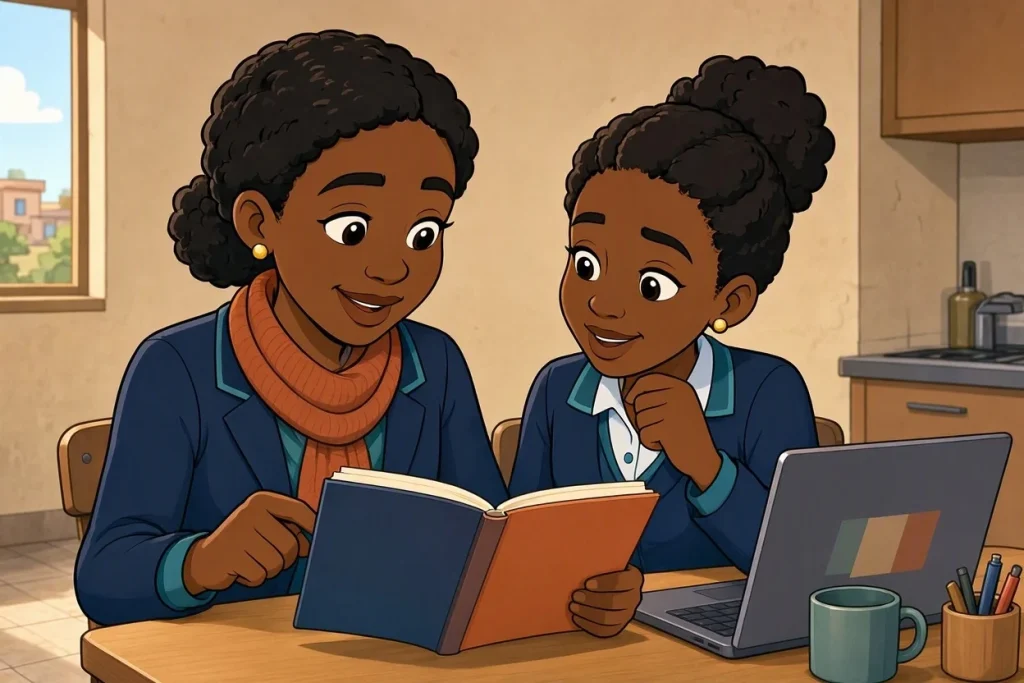
Prof. Kitso, pictured, is our cartoon study guide. You will meet him in the tip boxes and in our lessons.
Sources checked October 2026: University of Botswana undergraduate entry requirements; University of Manchester, entry requirements for Botswana; Cambridge International; Botswana Examinations Council. Entry rules change: always check the latest page of the university you are aiming for.